Direction and choices
Translate ambition into priorities, investment choices and realistic capacity commitments. Make alternatives, trade-offs and the consequences of starting, delaying or stopping work explicit.

OUR APPROACH
Our approach combines business focus with practical engagement. We work with the people whose decisions, knowledge and actions matter, establish clarity about what needs to be achieved and help organisations turn that direction into measurable results. Better is always possible.
THREE FOUNDATIONAL BELIEFS
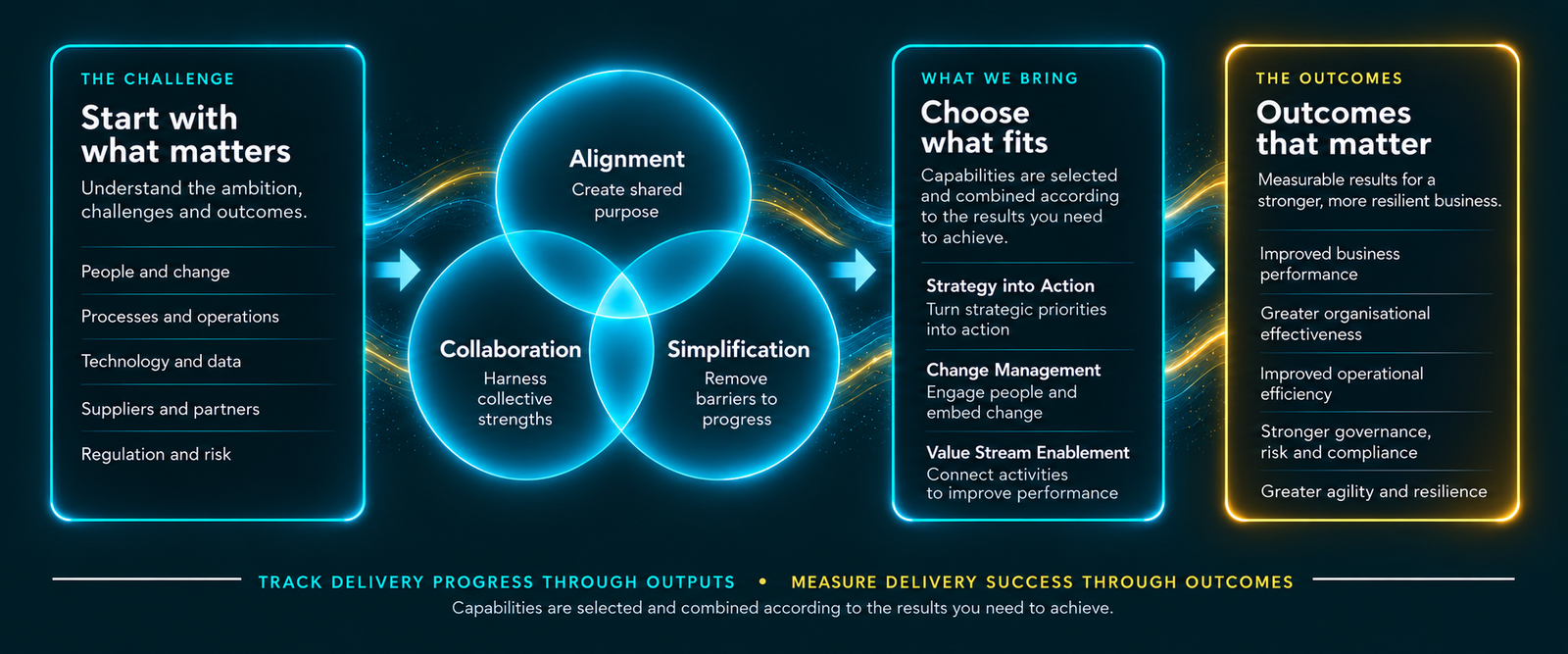
Alignment, Collaboration and Simplification underpin every engagement. These mutually reinforcing beliefs establish direction, bring relevant knowledge into decisions and remove obstacles to effective execution.
Creating a shared purpose
Alignment connects strategic intent with priorities, responsibilities and decisions. It creates clarity about what the organisation is trying to achieve, why it matters and who is accountable. Clear direction supports coordinated action without requiring agreement on every decision.
In practice: Bring leadership and delivery teams together, make assumptions and trade-offs explicit, and agree what success means and who owns the decisions.
Harnessing collective strengths
Complex problems cross organisational boundaries. Relevant knowledge may sit with executives, operational teams, customers, suppliers or partners. Collaboration makes appropriate perspectives available to improve decisions and execution; it does not replace leadership accountability.
In practice: Involve the people closest to the work, connect dependencies, encourage open dialogue and build working relationships that sustain delivery.
Removing barriers for greater impact
Unnecessary complexity consumes resources, slows decisions, conceals risk and creates friction. Simplification makes essential work clearer and more effective without removing safeguards required to protect performance.
In practice: Challenge redundant steps, make choices and responsibilities clearer, streamline workflows and focus effort on activity that creates value.
Alignment creates clarity, Collaboration brings together the right knowledge and experience, and Simplification makes effective action easier. Each reinforces the others throughout our work.
FROM BELIEF TO EXECUTION
Strategy must be translated into decisions, responsibilities, capabilities and ways of working that support the intended business results. An effective operating model connects how an organisation makes choices, deploys resources, carries out work, manages risk and measures performance.
HOW WE ENGAGE
We don't arrive with someone else's solution and try to make it fit your problems. Every organisation has its own challenges, priorities, people and operating realities.
We take the time to understand what needs to change, why it matters and what success looks like for you. We work with you to develop practical solutions that fit your business, build internal ownership and can be sustained long after our involvement ends.
Our success is measured by the outcomes you achieve, not the solutions we leave behind.
Start with the business problem and intended outcome. Engage relevant people, from executive leadership to frontline operations, wherever accountability, knowledge and impact sit. Understand constraints, trade-offs and risks before defining the response.
Turn competing demands into clear options, including value, cost, capacity, dependencies, risks and consequences. Support accountable decision-makers with the evidence and proportionate governance required to act.
Work with those responsible for implementation and operations to embed practical processes, capabilities and controls. Track outputs to understand execution and progress. Measure outcomes to determine whether intended business results have been achieved and sustained.
EXPERIENCE BEHIND THE APPROACH
Our experience spans strategic leadership and the operational functions that turn business decisions into results, including engineering, production, technology, finance, supply chain, business excellence and customer-facing operations.
Working across international organisations, we have seen how performance depends on relationships between functions, suppliers, partners and customers. We have led and influenced change across organisational boundaries, often without direct authority, where clarity, credibility and collaboration matter as much as formal structures.
That experience shaped our belief in Alignment, Collaboration and Simplification. Across Oil and Gas, Technology and Telecoms, Transport and Infrastructure, and Engineering and Automotive, the same principle holds: solutions must fit the business, deliver the required outcomes and remain effective after our involvement ends.
BETTER IS ALWAYS POSSIBLE
Better does not always mean easier. It can involve difficult decisions and fundamental changes. We help organisations understand the choices, engage the people who matter, execute with discipline and measure whether the required results have been achieved.